
About 300 sunny days a year, and 111 days at 100°F or more
Solar Panel Repair in Phoenix, AZ
Diagnostics, inverter work and roof-ready panel removal for Phoenix homes across all 15 urban villages.
- Free written estimate after we look at the roof, the inverter and your monitoring data
- Itemized pricing that separates parts, labor and any warranty claim work
- We check city permit and APS or SRP paperwork needs before equipment is changed
Why Phoenix Systems Need a Different Kind of Attention
Solar panel repair in Phoenix starts with the climate. The city averages about 300 sunny days a year, so a rooftop array here does a lot of work, and the same sun that powers it also bakes the inverter, the wiring and the roof under it. When production drops, an app shows an error, or a breaker keeps tripping, we find the cause and fix that part instead of guessing.
Heat is the main stress
Phoenix sees an average of 111 days a year at or above 100°F, and about 21 days above 110°F. The record is 122°F, set on June 26, 1990. Panels lose some output as cells get hotter, which is normal, so a lower afternoon number in July does not by itself mean something is broken. What heat does break is the equipment around the panels: string inverters mounted on sunny walls, connectors that loosen as they expand and contract every day, and wire insulation that turns brittle where it sits on hot tile or shingles.
When we test a system, we compare what each string or each microinverter is producing against its neighbors at the same time of day. One weak string next to healthy ones points to a fault, not to the weather.
What we work on across the city
- Inverter repair: error codes, shutdowns in afternoon heat, failed microinverters, communication drops.
- Solar wiring repair: loose MC4 connectors, chewed or sun-damaged conductors, ground faults, corroded junction boxes.
- Solar inspection and diagnostics: production checks, thermal imaging of panels, and a written list of what we found.
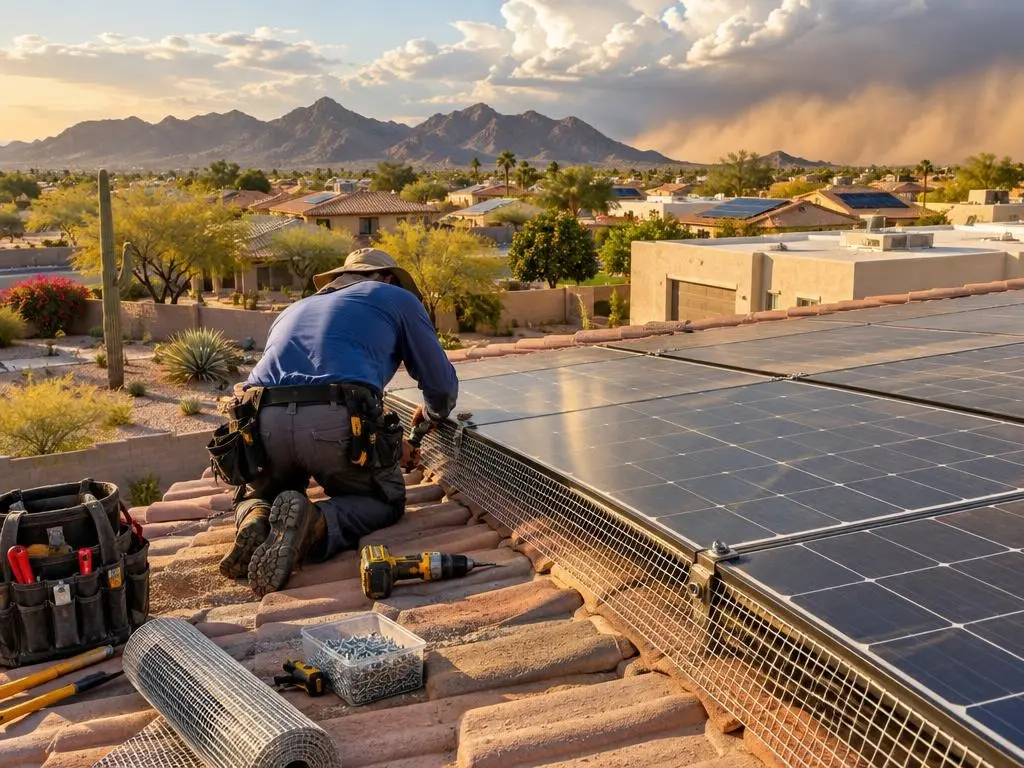
- Solar panel bird proofing: mesh guards that keep pigeons from nesting under the array.
- Solar panel cleaning: removing dust and droppings that build up between rains.
- Solar panel removal and reinstall: taking the array down so a roofer can work, then putting it back and testing it.
APS or SRP, check your bill
Two electric utilities serve the Phoenix area. Arizona Public Service serves about two-thirds of the metro area, mainly downtown and northern Phoenix and a wide area to the north and west. Much of the Salt River Project's territory overlaps with APS's, so your neighborhood alone does not tell you which one you have. Look at your bill before we visit. It matters because each utility has its own meter, interconnection and export-credit rules, and a repair that changes equipment may need to follow that utility's steps.
Monsoon and dust
The National Weather Service treats June 15 to September 30 as monsoon season. Storms can bring damaging wind, hail and dust, sometimes at haboob strength. After a big storm, the panels can carry a layer of dust that light rain turns into mud streaks, and loose conduit or a rattled rail can show up as a new fault. Phoenix gets only about 7.22 inches of rain a year at Sky Harbor, so dust tends to stay put between storms.
Older homes and historic districts
Much of Phoenix was built in the boom that followed World War II, when air conditioning made summer bearable; construction in 1959 alone exceeded everything built from 1914 to 1946. Many of those homes now have newer solar on older roofs. The city's Historic Property Register lists 35 historic residential districts, and the city reviews exterior alterations on designated properties. If your home is in one, ask the Historic Preservation Office about visible rooftop changes before we schedule work that alters the array layout.
Call (602) 461-8077 with your inverter brand, roughly when the system went in, and what you are seeing. We will tell you what we need to check first.
Phoenix Facts That Affect Your Solar
- Extreme heat. Phoenix averages 111 days a year at or above 100°F and about 21 days above 110°F; the record is 122°F on June 26, 1990.
- Sun hours. Roughly 3,872 hours of sunshine and about 300 sunny days a year, with only 7.22 inches of rain at Sky Harbor.
- Two utilities. APS serves about two-thirds of the metro area, mainly downtown and northern Phoenix; SRP's territory overlaps with much of it.
- Historic register. The Phoenix Historic Property Register includes 35 historic residential districts, and designated properties get city review of exterior alterations.
- Village planning. Phoenix is divided into 15 urban villages, each with a Village Planning Committee that reviews rezoning and General Plan cases.
Phoenix Questions
My Phoenix system makes less power in July than in April. Is it broken?
Not necessarily. Panels produce less as they get hotter, so a peak-summer dip is expected. A problem looks different: one string or microinverter far below the others, an error code, or a sudden drop that does not recover on a cooler day.
Does it matter whether I have APS or SRP?
Yes, for some repairs. Each utility has its own interconnection and metering rules. If we replace an inverter or change system equipment, we check what your utility requires before the system goes back online.
Can you work on a system another company installed?
Yes. We work on systems no matter who installed them. Have your inverter brand and any monitoring login handy so we can see the history before the visit.
Free Estimates in Phoenix, AZ
Tell us what your system is doing. We will start with diagnostics in Phoenix.
Solar Panel Repair Near Phoenix
- Solar Panel Repair in Ahwatukee Foothills, AZ
- Solar Panel Repair in Laveen, AZ
- Solar Panel Repair in Maryvale, AZ
- Solar Panel Repair in Arcadia, AZ
- Solar Panel Repair in Deer Valley, AZ
- Solar Panel Repair in Desert Ridge, AZ
- Solar Panel Repair in Sunnyslope, AZ
- Solar Panel Repair in Moon Valley, AZ
- Solar Panel Repair in South Mountain Village, AZ
- Solar Panel Repair in Encanto, AZ
- Solar Panel Repair in Camelback East, AZ
- Solar Panel Repair in North Mountain Village, AZ
- Solar Panel Repair in Paradise Valley Village, AZ
- Solar Panel Repair in Estrella Village, AZ
- Solar Panel Repair in Anthem, AZ
- Solar Panel Repair in New River, AZ
- Solar Panel Repair in Tolleson, AZ
- Solar Panel Repair in Avondale, AZ
- Solar Panel Repair in Guadalupe, AZ
- Solar Panel Repair in Tempe, AZ